
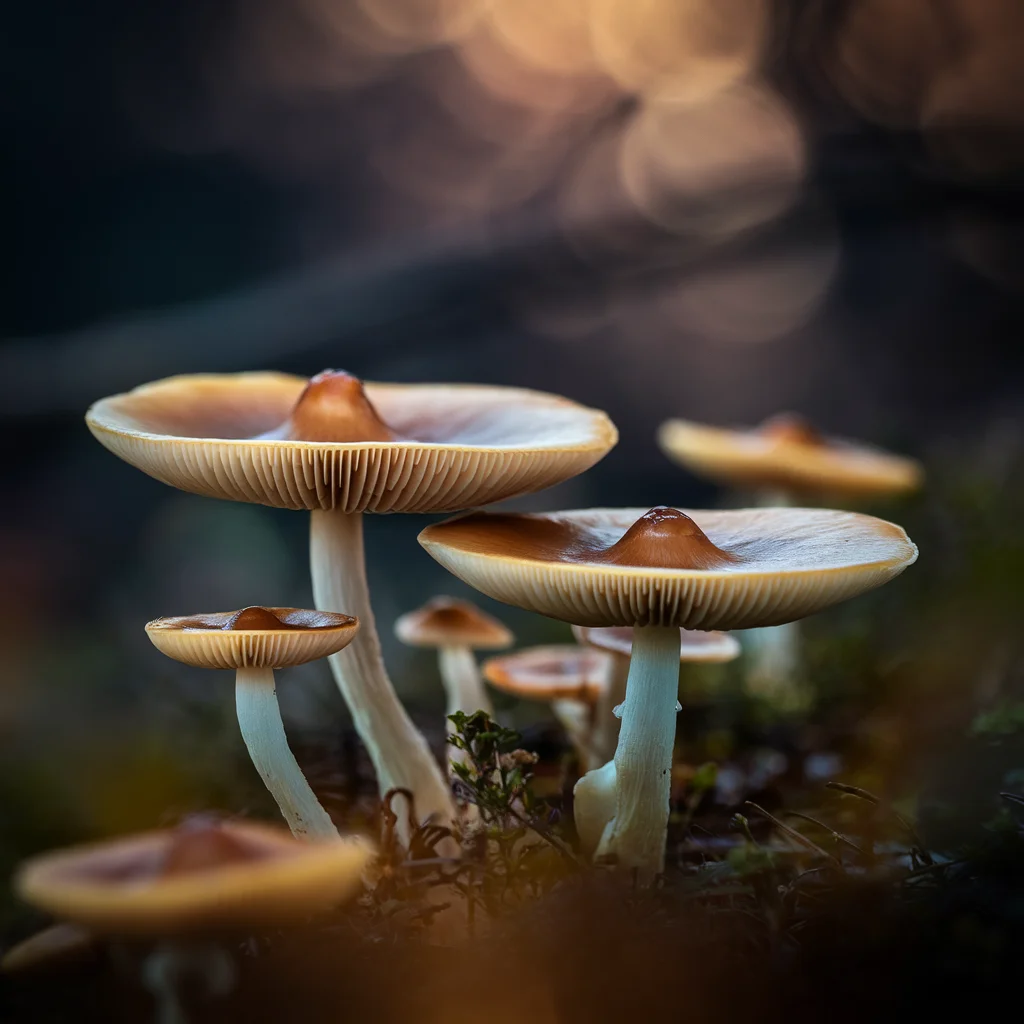
Psilocybe azurescens is a psilocybin-containing basidiomycete of the family Hymenogastraceae, first described by Paul Stamets and Jochen Gartz in 1995. It holds the distinction of being the most potent known psilocybin mushroom species, with psilocybin concentrations reaching 1.78%, psilocin up to 0.38%, and baeocystin up to 0.35% by dry weight — a combined tryptamine content that significantly exceeds all other documented Psilocybe species. The pileus is 3–10 cm, broadly convex to flat, caramel-brown when moist, fading to straw-colored, with a distinctive saucer-like shape at maturity. P. azurescens is native to a narrow coastal range in the Pacific Northwest of North America, primarily in Oregon and Washington, where it fruits in sandy soils among dune grasses (Ammophila arenaria) and in coastal deciduous wood debris. Its restricted natural range, extreme potency, and discovery by Paul Stamets have given it an almost legendary status in the mycological community.
#32
Žebříček popularity
Limited
Úroveň výzkumu
3
Reference
3
Klíčové sloučeniny
Psilocybin
Independent Research Review · Naposledy přezkoumáno 25. února 2026
PŘEHLED VĚDY.
Stupeň důkazů: C
Flying Saucers má omezený vědecký výzkum. Většina důkazů pochází z tradičního použití a předběžných studií.
Klíčový poznatek
Psilocybe azurescens holds a singular distinction in the world of psilocybin mushrooms: it is the most potent species ever documented. With combined psilocybin, psilocin, and baeocystin...
Tradiční použití
Flying Saucers se po staletí používá v tradičních léčebných systémech, zejména v tradiční čínské medicíně (TCM) a dalších asijských léčitelských praktikách.
Historický kontext: Tradiční použití nezaručuje účinnost ani bezpečnost. Moderní výzkum za účelem ověření tradičních tvrzení stále probíhá.
Psilocybe azurescens holds a singular distinction in the world of psilocybin mushrooms: it is the most potent species ever documented. With combined psilocybin, psilocin, and baeocystin concentrations that can exceed 2.5% of dry weight, Flying Saucers are roughly 2–3 times more potent than Psilocybe cubensis and even stronger than the already-potent Wavy Caps. Discovered by Paul Stamets — arguably the world's most famous mycologist — and formally described in 1995, this species has achieved an almost legendary status among mycology enthusiasts.
Flying Saucers are named for their distinctive cap shape: at maturity, the cap flattens out into a broad, disc-like form that resembles a flying saucer. They are native to a remarkably narrow geographic range — primarily the coastal dunes of Oregon and Washington in the Pacific Northwest of the United States, where they fruit among European beachgrass (Ammophila arenaria) and in sandy soils near the ocean. Stamets first encountered them near the mouth of the Columbia River, and the species remains most abundant in this coastal corridor.
The experience produced by P. azurescens is described by those who have encountered it as qualitatively different from other psilocybin species — not just "more" but fundamentally more intense, visual, and potentially overwhelming. At even modest doses (1–1.5 grams dried), users report powerful visual phenomena, profound emotional experiences, and the potential for ego dissolution. At higher doses, the experience can be genuinely challenging even for those experienced with other psilocybin species. This extreme potency demands particular respect and careful dosing.
One notable characteristic of P. azurescens is the phenomenon of "wood lover's paralysis" — a temporary condition reported by some users involving temporary loss of motor control or muscle weakness, sometimes lasting several hours. This effect is not well understood scientifically and appears to be more common with wood-loving Psilocybe species (azurescens, cyanescens, allenii) than with dung-loving species like cubensis. While not dangerous, it can be alarming if unexpected.
Flying Saucers are not commercially cultivated or sold. They are exclusively a wild species, and their restricted coastal habitat means they are encountered far less frequently than Liberty Caps or Wavy Caps. Outdoor cultivation in appropriate climates has been reported by hobbyist mycologists, but the species' specific substrate and climate requirements make it challenging to grow outside its native range.
This species is included for educational and completeness purposes. P. azurescens is illegal to cultivate or possess in most jurisdictions. For those in legal jurisdictions who may encounter this species: extreme caution with dosing is essential. Start with no more than 0.5–1 gram dried to assess individual sensitivity. The potency difference between azurescens and more common species like cubensis is dramatic, and treating them interchangeably is a recipe for an overwhelmingly intense experience. As with all psilocybin species, set, setting, and the presence of a trusted companion are paramount.
Flying Saucers Dávkování
Tyto informace slouží pouze ke vzdělávacím účelům a nenahrazují odbornou lékařskou radu. Vždy se poraďte s kvalifikovaným poskytovatelem zdravotní péče.
PODOBNÉ DRUHY.
Lékařsky přezkoumáno
Independent Research Review
Independent editorial team reviewing product labels, COAs, regulator records, and cited scientific literature. our editorial team reviews all mushroom encyclopedia entries for scientific accuracy, ensuring claims are supported by peer-reviewed research.
naposledy přezkoumáno: 25. února 2026
Click anywhere or press Escape to close
2-minute quiz
Find the protocol your nervous system is asking for.
Get a personalized mushroom path for focus, sleep, anxiety, energy, or emotional reset before you buy.
- 01 Maps your current state
- 02 Matches your mushroom archetype
- 03 Sends you to a personalized plan

