
Cordyceps and Lung Health: What the Clinical Evidence Actually Shows
A physician reviews the real clinical evidence behind Cordyceps mushroom and respiratory health — from COPD trial data to cordycepin's anti-asthma mechanisms.

Independent Research Review · Published May 23, 2026

📑 In questo articolo
- The Key Compounds Behind Cordyceps' Respiratory Effects
- COPD: The Strongest Clinical Evidence
- Asthma: Mechanism Meets Promise
- How Cordyceps May Improve Oxygen Utilization
- What Cordyceps Is Not
- Cordyceps Sinensis vs. Cordyceps Militaris: Which Is Better for Lungs?
- Dosing and Safety
- Practical Guidance for Respiratory Patients
- Frequently Asked Questions
- The Bottom Line
I'll be honest — when a patient first told me they were taking Cordyceps for their COPD, my reaction was a politely suppressed eye-roll. Another supplement, another set of extravagant claims. That was a few years ago. Since then, I've read enough peer-reviewed literature to revise my skepticism considerably. Not abandon it — I'm a physician, not a herbalist — but revise it.
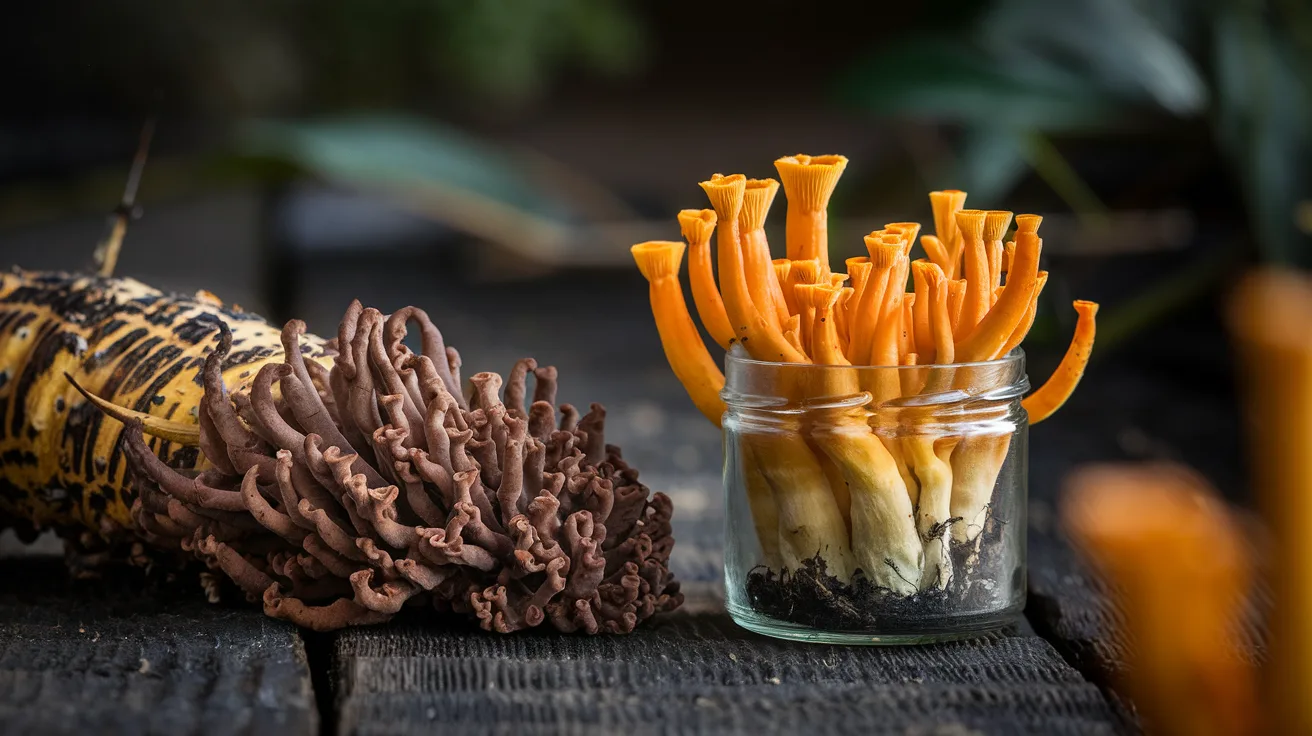
Cordyceps has an astonishing history. Cordyceps sinensis is a parasitic fungus that infects ghost moth caterpillars at altitude in the Tibetan Plateau, mummifying them and sprouting from their heads. (Take a moment with that image.) Tibetan herders noticed that yaks grazing on this fungus at high altitude seemed unusually vigorous, and the observation eventually made its way into Traditional Chinese Medicine pharmacopoeias, where Cordyceps has been used for centuries to "nourish the lungs and kidneys."
Modern science has since identified the active compounds responsible for these effects, run actual clinical trials, and produced a surprisingly robust body of evidence. Here's what it shows.
The Key Compounds Behind Cordyceps' Respiratory Effects
Before diving into clinical outcomes, it helps to understand what's actually doing the work. Cordyceps contains several biologically active ingredients, but three stand out for respiratory health:
- Cordycepin (3'-deoxyadenosine): A nucleoside analogue and the flagship bioactive compound. Anti-inflammatory, antioxidant, and — as we'll discuss — demonstrably active against airway inflammation.
- Cordyceps polysaccharides: Beta-glucan chains that modulate immune activity, reducing excessive inflammatory signaling without suppressing normal immune defense.
- Ergosterol: The fungal precursor to vitamin D2, with additional anti-inflammatory properties of its own.
According to a 2026 comprehensive review published in Phytotherapy Research by Zhang et al. — which analyzed 194 studies on Cordyceps and respiratory disease — these three compound classes work primarily by alleviating oxidative stress, inhibiting inflammatory cascades, and modulating immune response. [DOI: 10.1002/ptr.70358]
That's a reasonable mechanistic foundation. Now let's look at what happens when you actually give it to people.
COPD: The Strongest Clinical Evidence
Chronic Obstructive Pulmonary Disease is a progressive inflammatory lung condition affecting hundreds of millions worldwide. Standard of care — bronchodilators, corticosteroids, pulmonary rehab — helps, but doesn't stop the slow decline. So there's genuine interest in adjunct therapies.
Bailing Capsule is a Cordyceps sinensis product that has been extensively studied in China, and the results are striking. A 2024 meta-analysis published in Pharmaceutical Biology pooled data from 27 randomized controlled trials on Bailing Capsules in COPD patients. [DOI: 10.1080/13880209.2024.2415643] The findings:
- Significant improvements in FEV1 (forced expiratory volume in one second — the standard measure of airflow obstruction)
- Significant improvements in the FEV1/FVC ratio (a measure of how obstructed your airways are)
- Significant improvements in the 6-minute walk test (a proxy for exercise tolerance and quality of life)
- Marked reduction in acute COPD exacerbation events
- Improved overall quality of life scores
Twenty-seven randomized controlled trials is not nothing. That's not one lab getting lucky. The meta-analysis also conducted network pharmacology analysis identifying the core molecular targets as SRC, HIF1A, NFKB1, HDAC2, and PRKACA — which, if you don't speak molecular biology, are all proteins involved in inflammation and oxygen sensing.
Then, published in 2025, came an even more compelling piece of evidence: a multi-center, randomized, active-controlled trial in the Journal of Evidence-Based Medicine. [DOI: 10.1111/jebm.70091] This trial enrolled 240 COPD patients across multiple centers — mild to severe cases — and randomized them to one of two Cordyceps preparations for 24 weeks, followed by another 24-week follow-up period.
The key finding: Cordyceps significantly reduced the number of acute COPD exacerbations and prolonged the time to first exacerbation. In COPD management, reducing acute exacerbations is enormously clinically meaningful — each exacerbation accelerates disease progression and drives hospitalization costs.
I want to be transparent about the caveats: these trials were conducted in China with Chinese medicine products, many were industry-adjacent, and replication in Western clinical settings is limited. But the consistency across 27+ trials is hard to entirely dismiss.
Asthma: Mechanism Meets Promise
The asthma story is less about large clinical trials and more about impressive mechanistic work. A 2015 study published in International Immunopharmacology examined cordycepin in a mouse model of ovalbumin-induced asthma. [DOI: 10.1016/j.intimp.2015.04.017]
The results were notable:
- Cordycepin attenuated airway hyperresponsiveness — the tendency of asthmatic airways to overreact to stimuli
- Reduced mucus hypersecretion
- Lowered ovalbumin-specific IgE (a driver of allergic inflammation)
- Decreased eosinophils and macrophages in bronchoalveolar fluid
- Reduced IL-4, IL-5, and IL-13 — the classic Th2 cytokines that drive allergic asthma
- Blocked p38-MAPK and NF-κB signaling pathways
That last point matters. NF-κB is essentially the master switch for inflammation in the body. Anything that modulates it has broad therapeutic potential — and significant safety considerations worth monitoring.
The 2026 Phytotherapy Research review also noted that clinical trials with cordycepin showed promising anti-inflammatory activity that "reduced airway inflammation remarkably in asthmatic patients." Human data on asthma specifically is thinner than the COPD literature, but the mechanistic rationale is solid.
How Cordyceps May Improve Oxygen Utilization
Here's where the traditional use starts to make physiological sense. Tibetan herders weren't wrong — they just lacked the vocabulary to explain what they were seeing.
Cordyceps is thought to enhance ATP (adenosine triphosphate) synthesis via upregulation of mitochondrial function. More efficient ATP production means cells extract more energy from available oxygen. At altitude, where oxygen is scarce, this is genuinely advantageous. At sea level, it may translate to improved exercise tolerance — which is why Cordyceps became famous in sports nutrition after Chinese distance runners credited it for their 1993 record-breaking performances.
The connection to respiratory health is this: for COPD patients, exercise intolerance is largely driven by impaired gas exchange and muscle fatigue from poor oxygen utilization. If Cordyceps enhances mitochondrial efficiency, it could explain the 6-minute walk test improvements we see in the clinical data — independent of any direct bronchodilator effect.
What Cordyceps Is Not
I want to be clear about what this evidence does and does not support, because the supplement industry has a tendency to extrapolate aggressively.
| Claim | Evidence Status |
|---|---|
| Reduces COPD exacerbation frequency | Supported by multiple RCTs and meta-analysis |
| Improves lung function markers (FEV1) in COPD | Supported by meta-analysis of 27 RCTs |
| Anti-asthma effects via NF-κB suppression | Strong mechanistic data, limited human trials |
| "Cures" or reverses COPD | Not supported — adjunct therapy only |
| Replaces inhalers or corticosteroids | Absolutely not supported |
| Improves oxygen levels in healthy people | Mechanistically plausible, not well-demonstrated in clinical trials |
If you have COPD, asthma, or any serious respiratory condition: continue your prescribed medications. Cordyceps may be a worthwhile adjunct conversation to have with your pulmonologist, but it is not a replacement for evidence-based standard of care.
Cordyceps Sinensis vs. Cordyceps Militaris: Which Is Better for Lungs?
This question comes up constantly and deserves a direct answer. The clinical trials I've cited primarily used Cordyceps sinensis preparations (Bailing Capsule). However, wild C. sinensis is extraordinarily expensive — genuine wild-harvested caterpillar fungus can cost more than gold by weight — so most commercial supplements use either:
- Fermented Cordyceps sinensis mycelium (lab-grown, less expensive)
- Cordyceps militaris (cultivable on grain media, more cost-effective, higher natural cordycepin content)
Here's the nuance: C. militaris actually contains significantly higher concentrations of cordycepin than wild C. sinensis. The anti-asthma and anti-inflammatory studies using cordycepin as an isolated compound are therefore arguably most relevant to C. militaris products. The COPD clinical trials, however, used C. sinensis preparations specifically. Both species share polysaccharide profiles with overlapping activity.
My practical recommendation: look for a C. militaris fruiting body extract (not mycelium on grain substrate) with a stated cordycepin content. Third-party testing for cordycepin concentration is increasingly available from reputable brands.
Dosing and Safety
The 2026 Phytotherapy Research comprehensive review noted that "Cordyceps does not show obvious toxic side effects in preclinical and clinical studies" — which is reassuring for a compound that's been used for a thousand years and studied extensively in recent decades.
That said, relevant safety notes from a physician's perspective:
- Immunomodulation: Cordyceps modulates immune function. If you're on immunosuppressive therapy post-transplant, discuss with your doctor first.
- Anticoagulants: Some evidence suggests polysaccharides may have mild antiplatelet effects. If you're on warfarin or novel anticoagulants, monitor closely.
- Pregnancy: Insufficient data. Skip it during pregnancy and breastfeeding.
- Autoimmune conditions: Immune modulation cuts both ways. Consult your rheumatologist.
Standard supplemental doses used in the clinical literature range from 1,000–3,000 mg/day of extract. Many trials used higher doses. The 24-week treatment duration in the multicenter COPD trial gives me reasonable confidence in medium-term safety at these doses.
Practical Guidance for Respiratory Patients
If you have a respiratory condition and are curious about Cordyceps, here's how I'd approach it as a physician:
- Tell your doctor. I mean this literally. Not because it's dangerous, but because informed physicians track what their patients are taking, and good communication prevents adverse interactions.
- Choose quality products. Fruiting body extract, not mycelium on grain. Request a Certificate of Analysis (COA) that confirms cordycepin content and tests for heavy metals and contaminants.
- Allow adequate time. The clinical trials showing COPD benefit ran for 24 weeks. This is not a two-week experiment. Set a reasonable trial period.
- Track your baseline. If your doctor monitors your FEV1 or FVC, note those values before you start. You want objective data, not vibes.
- Don't discontinue standard medications. Cordyceps is adjunct therapy. If your inhaler works, keep using it.
Frequently Asked Questions
Can Cordyceps really help with COPD?
The evidence suggests it can meaningfully reduce acute exacerbation frequency and improve exercise tolerance as an adjunct to standard care. A 2024 meta-analysis of 27 randomized controlled trials showed significant improvements in FEV1, FEV1/FVC ratio, and 6-minute walk distance in COPD patients taking Cordyceps sinensis preparations. It is not a cure and should not replace prescribed therapies, but the evidence for adjunct benefit is more robust than I initially expected.
Is Cordyceps good for asthma?
The mechanistic data is compelling — cordycepin demonstrably suppresses the Th2 inflammatory pathways that drive allergic asthma, blocks NF-κB signaling, and reduces airway hyperresponsiveness in animal models. Human clinical data specifically for asthma is more limited than for COPD, but is promising. Discuss with your allergist or pulmonologist before incorporating it into your regimen.
Does Cordyceps improve breathing during exercise?
There's a plausible mechanistic argument — Cordyceps enhances mitochondrial ATP synthesis, improving cellular oxygen efficiency. The 6-minute walk test improvements seen in COPD trials reflect improved exercise tolerance. For healthy athletes, the evidence is less clear and results have been mixed in Western trials. The traditional use at high altitude suggests real physiological effect, but controlled data on healthy subjects is sparse.
The Bottom Line
My initial eye-roll was unwarranted. The respiratory evidence behind Cordyceps is substantive — particularly for COPD, where 27 randomized controlled trials and a multicenter prospective study converge on consistent benefit. The anti-asthma mechanistic work is rigorous enough to take seriously.
Is Cordyceps going to replace your pulmonologist? No. Will it reverse advanced COPD? No. But as an evidence-informed adjunct for people managing chronic respiratory conditions, the data makes a reasonable case. And for healthy individuals interested in respiratory efficiency and oxygen utilization — the thousand-year track record combined with a solid mechanistic foundation suggests it's more than Tibetan folklore.
As always: quality matters enormously in this supplement category. If the product can't tell you its cordycepin content, that's a red flag.
Sources: According to PubMed, the studies referenced in this article include Zhang et al. (2026) DOI: 10.1002/ptr.70358; Ma & Jin (2024) DOI: 10.1080/13880209.2024.2415643; Li et al. (2025) DOI: 10.1111/jebm.70091; Yang et al. (2015) DOI: 10.1016/j.intimp.2015.04.017.
Tag
Revisione editoriale a cura di
ShrooMap Editorial Team
Team editoriale indipendente che verifica etichette dei prodotti, certificati di analisi (COA), registri delle autorità e la letteratura scientifica citata.
Frequently Asked Questions
What does this article about "Cordyceps and Lung Health: What the Clinical Evidence Actually Shows" cover?
A physician reviews the real clinical evidence behind Cordyceps mushroom and respiratory health — from COPD trial data to cordycepin's anti-asthma mechanisms.
Who reviewed this article?
This article was editorially reviewed by ShrooMap Editorial Team, a independent editorial team.
What topics are related to this article?
This article covers topics including cordyceps, lung health, COPD, asthma, respiratory. Explore our blog for more articles on these subjects.
Articoli correlati

AHCC: The Shiitake-Derived Compound With the Most Compelling Immune Data You've Never Heard Of
10 min read
Cordyceps Militaris vs Sinensis: I Wasted $40 Before Learning the Difference
8 min read
Cordyceps for Athletic Performance & Energy: What the Research Actually Shows
12 min read
Esplora le categorie
⚖️ Confronto tra i prodotti
Esplorare il mondo dei funghi
Approfondite i profili delle specie, confrontate i prodotti e trovate i negozi più vicini a voi.