$24.99 $24.99/serving
View Review
Psilocybe semilanceata
Medizinisch geprüft von Dr. Irvine Russell, M.D.
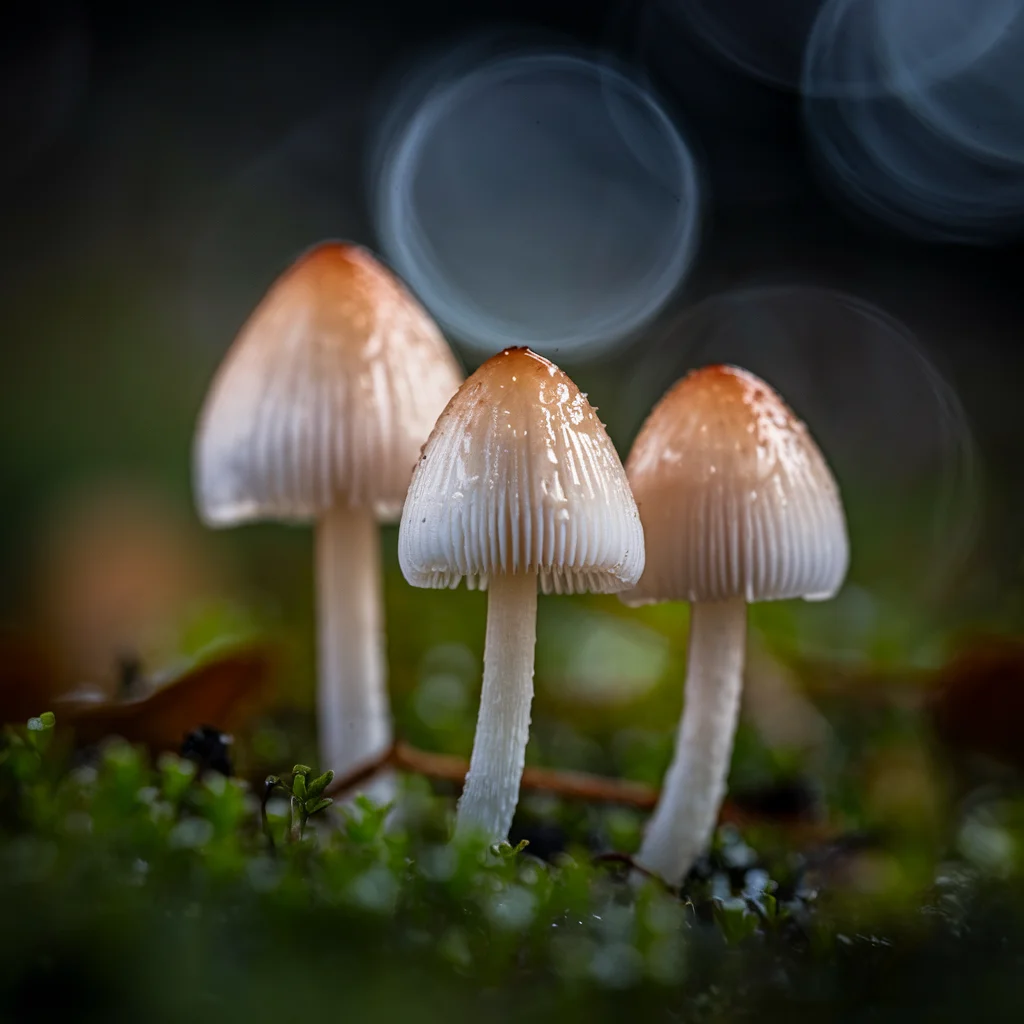
Psilocybe semilanceata is a saprotrophic psilocybin-containing mushroom of the family Hymenogastraceae, widely regarded as the most common and abundant wild psilocybin species in Europe and the British Isles. It is characterized by its small size (cap diameter 5–25 mm), distinctive conical to bell-shaped pileus with a pronounced papilla (nipple-like protrusion) at the apex, hygrophanous coloration ranging from chestnut brown when moist to pale straw-yellow when dry, and a thin, flexuous stipe (4–10 cm). P. semilanceata fruits in autumn (September–November) in acidic, nutrient-poor grasslands, particularly sheep and cattle pastures, across temperate regions of Europe, North America, and parts of Australasia. It was one of the first psilocybin species identified by Albert Hofmann in 1963 and contains psilocybin concentrations of 0.2–2.37% dry weight, making it moderately to highly potent. It is the most culturally significant psilocybin mushroom in European tradition.
#30
Beliebtheitsrang
Extensive
Forschungsniveau
3
Quellenangaben
4
Schlüsselverbindungen

Board-Certified Physician · Medical Reviewer · Zuletzt überprüft 25. Februar 2026
Liberty Cap wurde sowohl in präklinischen als auch in klinischen Studien umfassend untersucht. Mehrere Humanstudien haben den potenziellen Nutzen erforscht.
The Liberty Cap is arguably the most iconic wild psilocybin mushroom in Europe. Small, elegant, and unmistakable with its pointed, nipple-topped cap, Psilocybe semilanceata has been part of European...
Liberty Cap wird seit Jahrhunderten in traditionellen Medizinsystemen verwendet, insbesondere in der Traditionellen Chinesischen Medizin (TCM) und anderen asiatischen Heilpraktiken.
Historischer Kontext: Traditionelle Anwendung garantiert keine Wirksamkeit oder Sicherheit. Moderne Forschung zur Validierung traditioneller Behauptungen ist im Gange.
The Liberty Cap is arguably the most iconic wild psilocybin mushroom in Europe. Small, elegant, and unmistakable with its pointed, nipple-topped cap, Psilocybe semilanceata has been part of European culture — knowingly or unknowingly — for centuries. It was one of the first psilocybin species ever scientifically identified, analyzed by Albert Hofmann (the discoverer of LSD) in 1963, and remains the most commonly encountered wild psilocybin mushroom across the British Isles, Scandinavia, and continental Europe.
Liberty Caps fruit in autumn, typically from September through November, in acidic grasslands — particularly sheep and cattle pastures, parklands, and meadows. They are small mushrooms, with caps rarely exceeding 2.5 cm in diameter, but what they lack in size they make up for in potency. Psilocybin concentrations can reach up to 2.37% of dry weight in some specimens, placing them among the more potent Psilocybe species. A typical dose for a moderate experience is 1–2 grams of dried mushrooms, though potency varies significantly between individual specimens and locations.
The cultural significance of Liberty Caps in Europe cannot be overstated. They are the psilocybin mushroom that most European users first encounter, whether through deliberate foraging or accidental discovery. The UK's "magic mushroom season" in autumn is a well-known cultural phenomenon, and Liberty Caps have been the subject of extensive mycological research, harm reduction guidance, and legal debate across European countries.
Identification of Liberty Caps requires careful attention to detail. The key features are: a conical to bell-shaped cap with a distinctive pointed papilla (nipple) at the top; hygrophanous coloration that changes from chestnut brown when wet to pale straw when dry; a thin, wavy stem; and dark purple-brown spore print. They grow in grass, never on wood or dung. Critically, several potentially dangerous lookalike species exist, including some Conocybe and Galerina species — accurate identification is essential for safety.
Liberty Caps are not commercially cultivated or sold as a product. Unlike Psilocybe cubensis (which can be grown indoors on various substrates) or psilocybin truffles (which are sold legally in Dutch smartshops), Liberty Caps are exclusively a wild species that has resisted all commercial cultivation attempts. They require specific grassland conditions, symbiotic relationships with grass roots, and particular climate patterns that cannot be replicated commercially.
For harm reduction purposes: Liberty Caps should only be consumed by those in jurisdictions where psilocybin is legal or decriminalized. Accurate identification by an experienced forager is essential — never consume wild mushrooms based solely on photographs or descriptions. Start with a low dose to assess individual sensitivity. Have a trusted, sober companion present. Choose a comfortable, familiar environment. And remember that set (your mindset) and setting (your environment) are the most important factors in determining the quality of a psilocybin experience.
Top-Produkte mit verifiziertem Psilocybe semilanceata Extrakt.
Diese Informationen dienen nur zu Bildungszwecken und ersetzen keine professionelle medizinische Beratung. Konsultieren Sie immer einen qualifizierten Arzt.
Board-Certified Physician · Medical Reviewer
Board-certified physician affiliated with UC Irvine, the Gavin Herbert Eye Institute, and the UCI School of Medicine. Dr. Russell reviews all mushroom encyclopedia entries for scientific accuracy, ensuring claims are supported by peer-reviewed research.
Last reviewed: 25. Februar 2026
Click anywhere or press Escape to close