
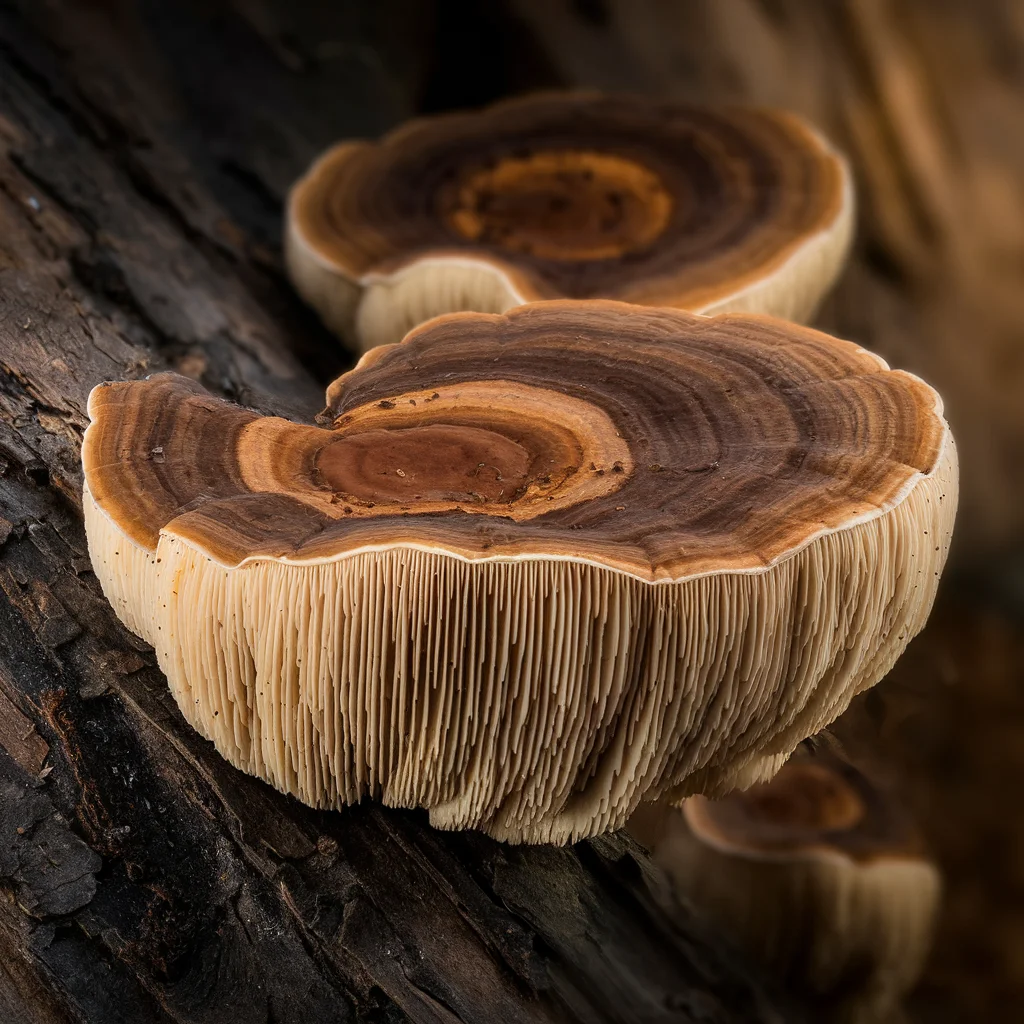
Ganoderma applanatum is a perennial polypore fungus of the family Ganodermataceae, closely related to the renowned Ganoderma lucidum (Reishi). It forms large, flat, semicircular to fan-shaped basidiocarps (up to 60 cm across) on dead or dying hardwood trees, particularly beech, oak, and maple. The upper surface displays concentric brown growth zones with a hard, woody texture, while the lower surface features a white pore layer that bruises brown when scratched — a property that has made it a canvas for artists, hence the common name. G. applanatum shares a similar triterpenoid and polysaccharide profile with G. lucidum, including ganoderic acids with documented anti-inflammatory, anti-tumor, and hepatoprotective activities, along with immunomodulatory beta-glucans.
#25
Populariteitsrangschikking
Limited
Onderzoeksniveau
2
Referenties
4
Belangrijke verbindingen
Triterpenes
Independent Research Review · Laatst beoordeeld 3 mei 2026
WETENSCHAPPELIJK OVERZICHT.
Bewijsgraad: C
Artist's Conk heeft beperkt wetenschappelijk onderzoek. Het meeste bewijs komt van traditioneel gebruik en voorlopige studies.
Belangrijk inzicht
Artist's Conk is a large, flat bracket fungus that you have probably walked past in the forest without realizing it was a close relative of the famous Reishi mushroom. Named for the remarkable...
Traditioneel gebruik
Artist's Conk wordt al eeuwenlang gebruikt in traditionele geneeskundige systemen, met name in de Traditionele Chinese Geneeskunde (TCM) en andere Aziatische geneeswijzen.
Historische context: Traditioneel gebruik garandeert geen werkzaamheid of veiligheid. Modern onderzoek om traditionele claims te valideren is gaande.
Artist's Conk is a large, flat bracket fungus that you have probably walked past in the forest without realizing it was a close relative of the famous Reishi mushroom. Named for the remarkable property of its white underside — which turns brown when scratched, allowing artists to etch detailed drawings that are preserved as the fungus dries — Ganoderma applanatum is one of the most common polypore fungi in temperate forests worldwide. It grows on dead or dying hardwood trees and can persist for decades, adding a new layer of growth each year.
From a health perspective, Artist's Conk shares many of the same beneficial compounds as its more famous cousin, Reishi (Ganoderma lucidum). Both species produce triterpenes, including ganoderic acids, which have demonstrated anti-inflammatory and immune-modulating properties in laboratory studies. Artist's Conk also contains immunomodulatory beta-glucans and has shown antibacterial activity in research, supporting its traditional use in wound healing applications.
Traditional use of Artist's Conk spans multiple cultures. Indigenous peoples in North America used it as a wound dressing and for respiratory complaints. In European folk medicine, it was used similarly for its antimicrobial properties. Chinese traditional medicine has long recognized the Ganoderma genus as a whole, though G. lucidum (Reishi) has received far more attention in both traditional and modern contexts.
Artist's Conk supplements are relatively niche compared to Reishi, but they are available from specialty mushroom supplement companies, typically in powder or tincture form. Some multi-mushroom blends include G. applanatum alongside other Ganoderma species. Typical dosages follow similar guidelines to Reishi — 500 mg to 2,000 mg per day of extract. The mushroom is also popular among foragers and wild-crafters who harvest it for personal use.
When sourcing Artist's Conk, wild-harvested specimens are the most common, as commercial cultivation is limited. If purchasing supplements, look for products that clearly identify the species as G. applanatum rather than generic "Ganoderma" labeling, which could refer to any species in the genus. Dual extraction (hot water plus alcohol) is recommended to capture both the water-soluble polysaccharides and the alcohol-soluble triterpenes.
Artist's Conk is best understood as a complement to Reishi rather than a replacement. For those interested in the Ganoderma genus, combining Artist's Conk with Reishi provides a broader spectrum of triterpenes and polysaccharides than either species alone. It is also valued by the ancestral health and traditional herbalism communities for its long history of human use and its accessibility as a wild-foraged mushroom.
Artist's Conk Dosering
Deze informatie is uitsluitend bedoeld voor educatieve doeleinden en mag professioneel medisch advies niet vervangen. Raadpleeg altijd een gekwalificeerde zorgverlener.
VERGELIJKBARE SOORTEN.
Medisch beoordeeld door
Independent Research Review
Independent editorial team reviewing product labels, COAs, regulator records, and cited scientific literature. our editorial team reviews all mushroom encyclopedia entries for scientific accuracy, ensuring claims are supported by peer-reviewed research.
Laatst beoordeeld: 3 mei 2026
Click anywhere or press Escape to close