
Lion's Mane vs Adderall: What the Research Actually Says
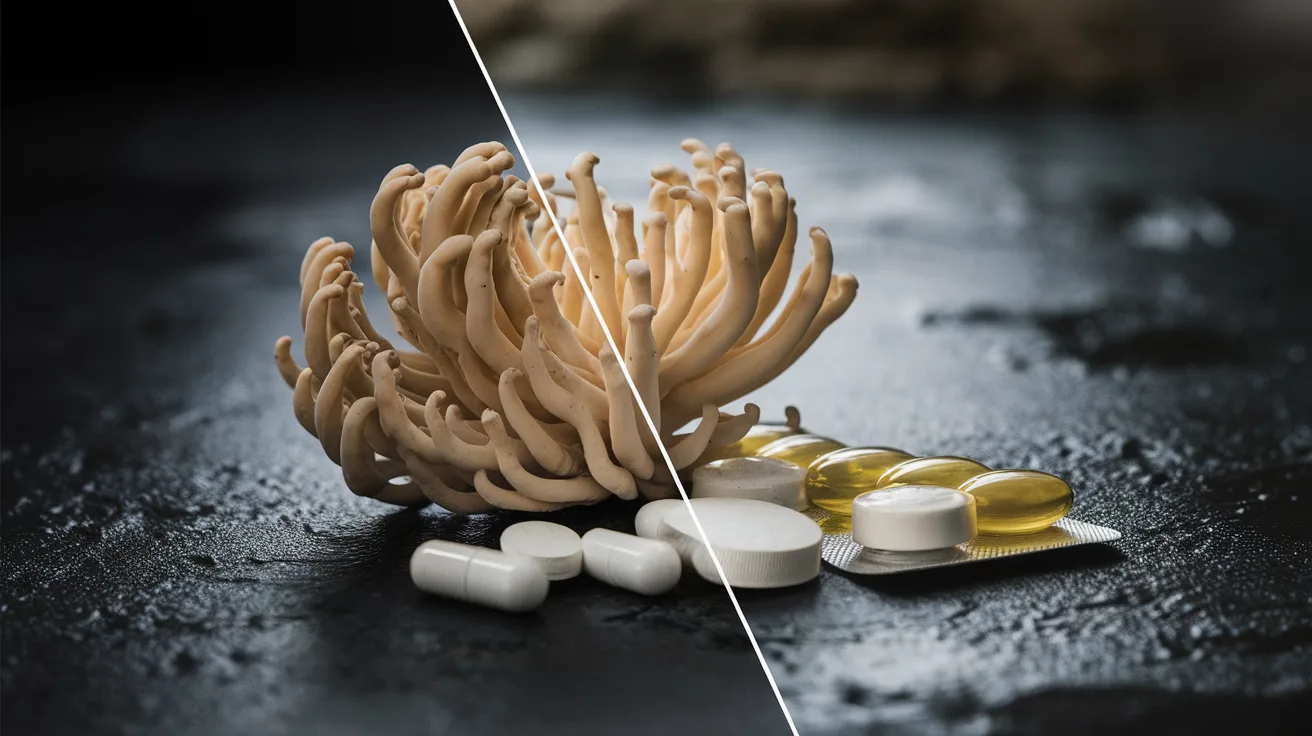
A science-backed comparison of lion's mane mushroom and Adderall for focus and cognitive enhancement. What does the research really show?

Board-Certified Physician · Medical Reviewer · Published February 8, 2026
📑 In This Article
If you've spent any time in nootropic communities, you've seen the claim: "Lion's mane is natural Adderall." It shows up in TikTok videos, Reddit threads, and marketing copy for dozens of mushroom supplement brands. But is there any truth to it?
The short answer: they're fundamentally different substances that work through completely different mechanisms. The longer answer is more nuanced — and more interesting.
How Adderall Works
Adderall is a combination of amphetamine salts (75% dextroamphetamine, 25% levoamphetamine) that increases dopamine and norepinephrine levels in the brain by blocking reuptake and promoting release. It's a Schedule II controlled substance prescribed for ADHD and narcolepsy.
The effects are immediate and pronounced: increased focus, alertness, motivation, and energy. But they come with significant tradeoffs — potential for dependence, cardiovascular stress, appetite suppression, insomnia, anxiety, and a well-documented crash when the medication wears off.
How Lion's Mane Works
Lion's mane mushroom (Hericium erinaceus) contains two unique compound groups — hericenones (found in the fruiting body) and erinacines (found in the mycelium) — that stimulate the production of nerve growth factor (NGF). See our full lion's mane profile.
NGF is a protein essential for the growth, maintenance, and survival of neurons. Unlike amphetamines, lion's mane doesn't flood your synapses with neurotransmitters. Instead, it may support the underlying infrastructure of your nervous system over time.
The Research: What We Actually Know
Lion's Mane Human Studies
The most-cited study is Mori et al. (2009), which gave 30 elderly Japanese adults with mild cognitive impairment either lion's mane or placebo for 16 weeks. The lion's mane group showed significantly improved cognitive function scores — but the improvements disappeared 4 weeks after they stopped supplementation.
A 2023 study from the University of Queensland (Martínez-Mármol et al.) found that lion's mane extract and its active compound N-de phenylethyl isohericerin (NDPIH) promoted neurite outgrowth and enhanced memory in mice. The researchers identified a novel mechanism involving the ERK1 signaling pathway.
A 2020 study (Saitsu et al.) found that 12 weeks of lion's mane supplementation improved cognitive test scores in healthy 50+ year-old Japanese adults compared to placebo.
Nagano et al. (2010) showed that 4 weeks of lion's mane cookies (yes, cookies) reduced depression and anxiety scores in menopausal women compared to placebo.
Key Differences in Evidence Quality
Adderall has decades of rigorous, large-scale clinical research behind it. Lion's mane research, while promising, consists mostly of small studies (typically 30-80 participants), often in elderly populations, with varying extract types and dosages.
We don't yet have large, well-controlled studies examining lion's mane specifically for focus and productivity in healthy young adults — which is the demographic most interested in it as an Adderall alternative.
Direct Comparison
| Factor | Adderall | Lion's Mane |
|---|---|---|
| Onset | 30-60 minutes | 2-4 weeks (cumulative) |
| Mechanism | Dopamine/norepinephrine increase | NGF stimulation |
| Effect type | Acute, strong, time-limited | Subtle, gradual, sustained |
| Dependence risk | Moderate to high | None documented |
| Side effects | Significant | Minimal (rare GI upset) |
| Legal status | Schedule II prescription | Legal supplement |
| Evidence quality | Extensive clinical trials | Promising but limited |
| Cost | $30-300/month (insurance dependent) | $20-50/month |
What Users Actually Report
Anecdotal reports from the nootropic community suggest that lion's mane provides a subtle improvement in mental clarity, verbal fluency, and reduced brain fog — typically noticed after 2-4 weeks of consistent use. Nobody reports the laser-like hyperfocus that amphetamines produce.
The people who seem most satisfied with lion's mane as a "focus supplement" are typically those dealing with general brain fog, mild concentration issues, or age-related cognitive decline — not severe ADHD symptoms.
Can You Combine Them?
Some people use lion's mane alongside prescribed ADHD medication. There are no documented drug interactions between lion's mane and amphetamines, but this should always be discussed with a healthcare provider. Some users report that lion's mane helps smooth out the crash when Adderall wears off.
The Stacking Approach
For those looking to optimize focus naturally, lion's mane is often combined with other compounds in what's called a "stack." Common pairings include:
- Lion's mane + cordyceps — Cognitive support plus natural energy
- Lion's mane + L-theanine + caffeine — Focus with calm alertness
- Lion's mane + bacopa monnieri — Dual-pathway memory support
Check out our guide to the best mushroom stacks for focus, sleep, and energy for detailed protocols.
How to Choose a Quality Lion's Mane Supplement
If you want to try lion's mane for cognitive support, quality matters enormously:
- Choose fruiting body extracts (for hericenones) or products that include both fruiting body and mycelium (for erinacines)
- Look for dual extraction (hot water + ethanol)
- Dosage: most studies used 500-3000mg per day
- Demand a third-party COA showing beta-glucan content above 20%
Browse our mushroom capsules and gummies categories to find verified lion's mane products, or use our comparison tool to evaluate options side by side.
The Bottom Line
Lion's mane is not "natural Adderall." It doesn't work like Adderall, it doesn't feel like Adderall, and it won't replace Adderall for people with genuine ADHD. But that doesn't mean it's useless. It works through a fundamentally different — and arguably more sustainable — mechanism that supports long-term brain health rather than providing acute neurotransmitter stimulation.
Think of it this way: Adderall is like flooring the gas pedal. Lion's mane is like upgrading the engine over time. Both have their place, and they're not really competing.
Tags
Medically Reviewed By
Dr. Igor I. Bussel, M.D.
Board-certified physician affiliated with the University of California, Irvine (UCI), the Gavin Herbert Eye Institute, and the UCI School of Medicine.
Related Articles



Explore the Mushroom World
Dive deeper into species profiles, compare products, and find stores near you.