🏆 Editor's Pick 🏆

Lab VerifiedThis product has been independently lab tested with full COA results available. Beta-glucan content, heavy metals, microbials, and potency have been verified.
$55.00 $1.83/serving
View Review
Trametes versicolor
Revisado médicamente por Dr. Irvine Russell, M.D.
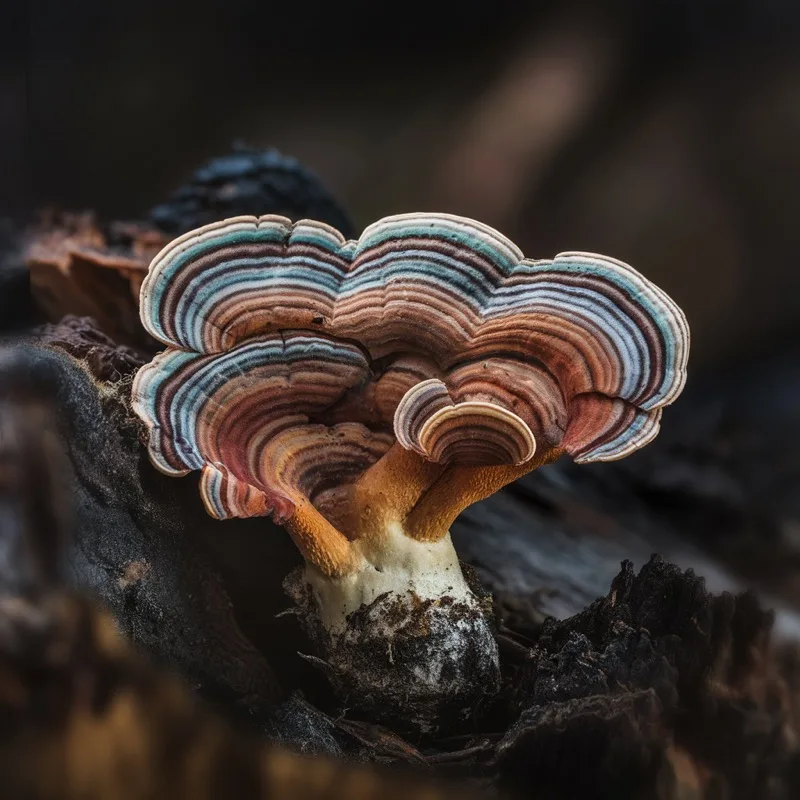
Trametes versicolor is a polypore mushroom in the family Polyporaceae, found worldwide on dead and decaying hardwood logs and stumps. Its morphology is characterized by thin, leathery, fan-shaped fruiting bodies with distinct concentric zones of varying colors. This white-rot fungus possesses significant pharmacological properties, primarily attributed to its protein-bound polysaccharides — Polysaccharide-K (PSK) and Polysaccharide-Peptide (PSP) — which are known for their immunomodulatory effects and have been used as approved adjunct cancer therapies in Japan since 1977.
#5
Clasificación de popularidad
Extensive
Nivel de investigación
6
Referencias
4
Compuestos clave

Board-Certified Physician · Medical Reviewer · Última revisión 12 de febrero de 2026
Turkey Tail ha sido ampliamente estudiado tanto en investigación preclínica como clínica. Múltiples ensayos en humanos han investigado sus beneficios potenciales.
Turkey Tail is arguably the most clinically validated functional mushroom in the world — not because supplement companies funded the research, but because the Japanese government approved its key...
Turkey Tail se ha utilizado en sistemas de medicina tradicional durante siglos, particularmente en la Medicina Tradicional China (MTC) y otras prácticas curativas asiáticas.
Contexto histórico: El uso tradicional no garantiza eficacia ni seguridad. La investigación moderna está en curso para validar las afirmaciones tradicionales.
Turkey Tail is arguably the most clinically validated functional mushroom in the world — not because supplement companies funded the research, but because the Japanese government approved its key extract as a pharmaceutical in 1977 and has been covering it under national health insurance ever since. The compound, PSK (Polysaccharide-K), has been studied in hundreds of clinical trials, used in oncology for nearly 50 years, and is co-administered with standard cancer treatments at major hospitals throughout Japan and China.
Turkey Tail (Trametes versicolor) is one of the most common mushrooms worldwide, growing on fallen logs in virtually every temperate forest. Thin, leathery, fan-shaped brackets with concentric bands of brown, tan, and cream — unmistakably similar to a wild turkey's tail feathers. Despite being common, it's not eaten as food — far too tough. Its medicinal value lies in water-soluble polysaccharides extracted through hot water brewing.
In Japan it's called "Kawaratake," in China "Yun Zhi" (cloud mushroom). Traditional uses consistently emphasized lung health, digestive support, and bolstering the body's defensive qi. The scientific chapter began when a Japanese chemical engineer noticed a neighbor's unusual cancer recovery after drinking Turkey Tail tea. His son's company isolated PSK, completed clinical trials, and won government approval by the 1970s. PSK is now prescribed to tens of thousands of cancer patients annually in Japan.
⚡ Key Fact
PSK (Polysaccharide-K) from Turkey Tail has been used as an approved adjunct cancer therapy in Japanese hospitals since 1977 — nearly 50 years of mainstream pharmaceutical use. Multiple meta-analyses show improved 5-year survival rates when PSK is added to conventional cancer treatment.
Turkey Tail's two primary compounds are PSK and PSP (Polysaccharide-Peptide) — protein-bound polysaccharides that activate macrophages, dendritic cells, and NK cells through TLR-2 and dectin-1 signaling. PSK stimulates T-cell proliferation and enhances cytotoxic T-lymphocyte activity — the immune cells most responsible for targeting cancer cells. In clinical settings, PSK helps restore immune competence during post-treatment immune depression.
Beyond immunotherapy, Turkey Tail has significant prebiotic effects. A 2014 study by Talbott and Talbott demonstrated Turkey Tail significantly altered gut microbiome composition — increasing Bifidobacterium and Lactobacillus while reducing pathogenic species. Since gut microbiome composition profoundly influences immune function and mental wellbeing, this prebiotic dimension explains broader health effects beyond direct immunostimulation.
💊 Recommended Dosage
1,000–3,000 mg/day of fruiting body hot water extract. Japanese oncology uses PSK at 3,000 mg/day. For gut health, the lower range (1,000–2,000 mg/day) is typically sufficient. Hot water extraction is critical — PSK and PSP are water-soluble polysaccharides. Look for ≥30% beta-glucan content and specified fruiting body origin.
Mejores productos con extracto verificado de Trametes versicolor extractos.


Esta información es solo con fines educativos y no debe reemplazar el consejo médico profesional. Consulte siempre con un profesional de la salud cualificado.
Board-Certified Physician · Medical Reviewer
Board-certified physician affiliated with UC Irvine, the Gavin Herbert Eye Institute, and the UCI School of Medicine. Dr. Russell reviews all mushroom encyclopedia entries for scientific accuracy, ensuring claims are supported by peer-reviewed research.
Last reviewed: 12 de febrero de 2026
Click anywhere or press Escape to close