
Fruiting Body vs Mycelium: Why Your Expensive Mushroom Supplement is Just Oats
Are you paying $40 for ground-up oats? Discover the dirtiest secret in the functional mushroom industry: the mycelium on grain (MOG) scam.

Board-Certified Physician · Medical Reviewer · Published February 24, 2026
📑 In This Article
I want you to go into your kitchen right now. Seriously. Get up, open your cabinet, and grab that $40 bottle of "functional mushroom" powder you bought because some guy on a podcast told you it would fix your brain.
Look at the back. Read the tiny print under the supplement facts.
Does it say "Myceliated brown rice"? Or maybe "Mycelial biomass"? Or better yet, "Full spectrum"?
If it does, I have some bad news. You are literally eating overpriced oatmeal.
And you aren't the only one. I did the exact same thing back in 2024. I dropped $65 on this gorgeous glass jar of what I thought was pure Lion's Mane extract. My brain was supposed to turn into a supercomputer. Instead, I just got gassy. Why? Because I didn't know the difference between a mushroom's fruiting body and its mycelium.
And more importantly — I didn't know about the biggest scam in the supplement industry.
The "mycelium on grain" grift.
Let's break this down so you never get ripped off again. Because by the time you finish reading this, you are going to be so angry at these companies. Good. You should be.
What Actually Is a Mushroom?
Before we get into the scam, we need to do like thirty seconds of biology. Don't worry, I failed high school bio. I'll keep it simple.
A fungus has two main parts.
1. The Mycelium: This is the root system. It lives underground or inside a log. It looks like a giant, fuzzy, white web. It creeps through the dirt, eating dead stuff, decomposing wood, and just generally vibing in the dark. It is the living, breathing network that sustains the organism. 2. The Fruiting Body: This is the actual mushroom. The thing that pops out of the ground. The thing with the cap and the stem. The part you slice up and put on a pizza.
When we talk about mushrooms — historically, medicinally, culinarily — we are almost always talking about the fruiting body. For thousands of years, Traditional Chinese Medicine practitioners were out in the woods looking for the actual fruiting bodies of Reishi or Chaga. They weren't digging up dirt to boil the roots.
The fruiting body is where the magic happens. It's the reproductive organ of the fungus. It's packed with the dense, complex compounds — the beta-glucans, the triterpenes, the hericenones in Lion's Mane — that actually do the things you want them to do.
The mycelium? It's cool. It's an amazing organism. But it's not a mushroom.
It's just the roots.
So Why Are Companies Selling You Roots?
Money. It's always money.
Growing real mushrooms — fruiting bodies — is hard. It takes time. You have to inoculate logs or massive bags of substrate. You have to control the humidity, the light, the temperature, the CO2 levels. You have to wait months for the mushrooms to actually sprout. Then you have to harvest them by hand. Then you have to dry them. Then you have to extract them.
It's a massive pain in the ass. And it's expensive.
A kilogram of pure, dual-extracted fruiting body mushroom powder from a reputable farm can cost $60 to $200 wholesale, depending on the species.
Now, let's look at the alternative.
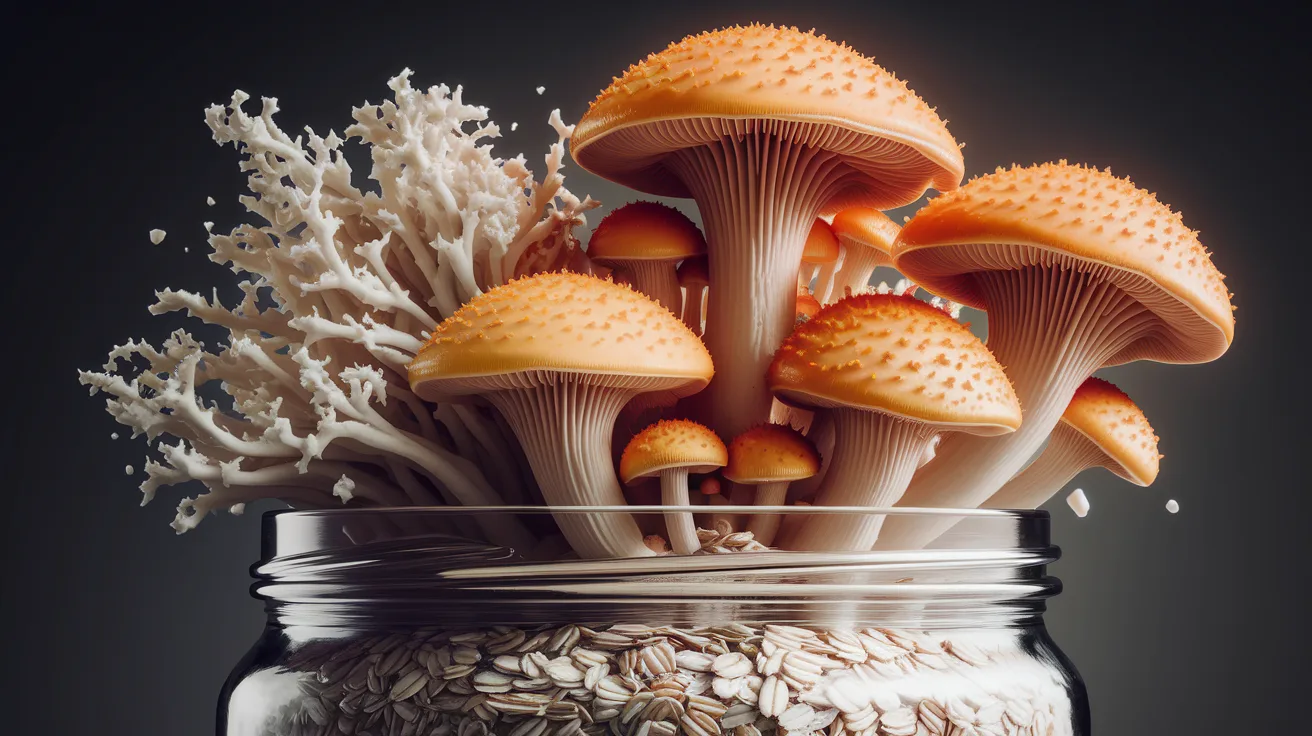
What if you didn't bother growing the mushroom at all? What if you just took a plastic bag full of sterilized oats or brown rice, squirted some mycelium spores into it, and left it in a warm room for two weeks?
The mycelium will grow. It will eat the oats. It will form a big, solid brick of fuzzy white grain.
And here's the kicker. Instead of waiting for mushrooms to pop out of that brick... these companies just grind up the entire brick. The mycelium AND the oats. All of it.
They dry it out, pulverize it into a fine brown powder, slap a picture of a beautiful, majestic Cordyceps mushroom on the label, and sell it to you for $40 a bottle.
This is called MOG. Mycelium On Grain.
And it costs them maybe $5 a kilogram.
The "Full Spectrum" Lie
Now, if you confront one of these companies on Instagram or TikTok, they'll hit you with their favorite buzzword.
"We use full-spectrum mushrooms!"
They claim that by giving you the mycelium, the primordia (baby mushrooms), and the grain, they are giving you the "entire life cycle" of the fungus. They'll tell you that the mycelium has different, magical compounds that the fruiting body doesn't have.
Look, this isn't entirely a lie. Mycelium does contain some active compounds. For example, in Lion's Mane, the mycelium contains erinacines, which are great for nerve growth factor.
But there's a massive, glaring problem.
When you buy a "mycelium" supplement grown on grain, you are mostly buying grain.
Think about it. The mycelium cannot be separated from the oats it's growing on. It's impossible. It's like trying to separate the roots of a potted plant from the soil. So when they grind up that brick, you are getting maybe 30% mycelium and 70% unfermented, plain old starch.
You are paying a massive premium for rice powder.
This is why, when you look at a Certificate of Analysis (if they even have one, which most of these scammers don't), the "alpha-glucan" content is off the charts.
Alpha-Glucans vs Beta-Glucans (The Real Test)
Let's get nerdy for a second, because this is the only way you can actually prove a brand is screwing you.
Mushrooms contain complex sugars called polysaccharides. The good ones — the ones that boost your immune system, fix your brain, and give you energy — are called Beta-Glucans.
Grain (oats, rice, wheat) contains a different type of sugar. Alpha-Glucans. Also known as starch. The stuff that makes bread fluffy.
A pure mushroom fruiting body extract will have high Beta-Glucans (usually 20% to 30%) and extremely low Alpha-Glucans (less than 5%). Because mushrooms don't contain starch.
A Mycelium on Grain supplement will have terrible, pathetic Beta-Glucan levels (maybe 1% or 2%) and massive Alpha-Glucan levels (often 30% to 50%).
Because, again... it's just oats.
I literally tested a wildly popular brand last year. I won't name them because they love suing people, but they sponsor every single podcast you listen to. Their packaging is beautiful. Their marketing is genius.
I sent their product to an independent lab.
Beta-glucans: 1.2%. Alpha-glucans (starch): 48%.
Half the bottle was just ground-up rice. For sixty dollars. I could have bought a 50-pound bag of rice at Costco for half the price and just stared at a picture of a mushroom while I ate it. It would have had the exact same health benefits.
The At-Home Water Test
You don't actually need to send your supplements to an expensive lab to figure out if you've been scammed. You can do it right now in your kitchen with a glass of water.
Grab a clear glass. Fill it with warm water. Dump a scoop of your mushroom powder in and stir it up.
Here is what happens if you have a real, high-quality fruiting body extract: It dissolves. Almost completely. Because an extract is essentially a dehydrated tea. All the non-soluble fiber and chitin have been removed during the extraction process. The water will turn dark brown or black, like instant coffee, and there won't be much sludge at the bottom.
Here is what happens if you have ground-up mycelium on grain: It clumps up. It floats. It refuses to dissolve. The water turns a cloudy, muddy tan color, and a thick sludge of starch settles at the bottom of the glass.
Why? Because starch doesn't dissolve in water. It just gets soggy. You just made a really sad bowl of cold oatmeal.
Drink it if you want. But don't expect it to cure your brain fog.
How the Scammers Started
You might be wondering how an entire industry got away with this for over a decade. It actually started in the 1990s. And the craziest part? It wasn't originally a scam.
Back then, the functional mushroom market in the US was practically nonexistent. A few brilliant mycologists (you probably know the famous guy with the beard and the mushroom hat) realized that Americans were never going to eat weird, bitter, medicinal mushrooms. The supply chain from Asia didn't exist yet in a reliable way.
So they needed a way to produce mushroom products stateside, cheaply, and at scale.
They figured out they could inoculate Uncle Ben's rice bags or giant plastic tubs of grain with mycelium, let it grow, freeze-dry the whole thing, and grind it into pills. It was a genuine attempt to make mycology accessible.
But then the wellness boom happened. Podcasters started screaming about neuroplasticity. Mushroom coffee became a hundred-million-dollar industry overnight.
Suddenly, massive venture-backed companies realized they could buy these cheap, starchy mycelium bricks, slap incredible branding on them, and sell them for a 2000% markup. They weaponized the 1990s technique.
They realized that the average consumer doesn't know the difference between a fungal root system and a fruiting body. And they absolutely exploited that ignorance.
Species by Species Breakdown
Let's look at exactly how this ruins the specific mushrooms you're taking.
Reishi: Reishi is the mushroom of immortality. It's supposed to calm your nervous system and help you sleep. The magic in Reishi comes from triterpenes. Triterpenes are what make Reishi intensely bitter. They are only found in the fruiting body. If your Reishi supplement isn't bitter, it's fake. Mycelium on grain Reishi has almost zero triterpenes.
Turkey Tail: The most heavily researched mushroom on earth for immune support. The entire reason it works is because of specific beta-glucans called PSK and PSP. Where are they found? The fruiting body. The mycelium has terrible concentrations.
Lion's Mane: This is the tricky one. As I mentioned earlier, Lion's Mane mycelium actually does contain erinacines, which are great for the brain. But — and this is a massive but — when grown on grain, the concentration is so diluted by the starch that it's useless. If you want erinacines, you need pure liquid-fermented mycelium, not grain. Otherwise, stick to the fruiting body, which is packed with hericenones that actually cross the blood-brain barrier.
The Liquid Exception
Now, I have to be fair. There is ONE exception to the mycelium rule.
Liquid fermentation.
Some really high-end companies are starting to grow mycelium in giant vats of liquid nutrient broth instead of on solid grain. When the mycelium is done growing, they drain the liquid away, leaving behind pure, 100% mycelium. No grain. No starch. No filler.
This is actually incredible technology, especially for species like Cordyceps (the CS-4 strain is grown this way because wild Cordyceps sinensis costs $20,000 a kilo and requires a dead caterpillar, which is gross).
But you have to read the fine print. If a company is doing liquid fermentation, they will brag about it. It will be all over their website. Because it's expensive and difficult.
If they just say "mycelial biomass" or "mycelium" and don't mention liquid fermentation? It's oats, baby.
How to Protect Your Wallet
So how do you actually buy a real mushroom supplement? How do you navigate this absolute minefield of marketing garbage?
It's actually really simple. You just have to know exactly what words to look for on the back of the bag.
1. Look for "Fruiting Body" It should explicitly state "100% Fruiting Body" in the ingredients. Not "Mushroom blend." Not "Proprietary matrix." If it doesn't say fruiting body, put it back on the shelf.
2. Look for "Extract" Mushrooms have a tough cellular wall made of chitin. Yes, the same stuff crab shells are made of. Your stomach acid cannot break down chitin. If you just eat raw mushroom powder, the beneficial compounds pass right through you.
The supplement must be an "Extract." Usually hot water extracted, or dual-extracted (water and alcohol). This melts away the chitin and makes the compounds bioavailable. If the bag just says "Mushroom powder," you're paying for expensive fiber.
3. Check the Beta-Glucans The best companies test every single batch and print the beta-glucan percentage right on the bag. You want to see at least 20%. If they list "Polysaccharides" instead of Beta-Glucans, be highly suspicious. Remember, grain starch is a polysaccharide. They use that word to hide the oats.
4. Check the Taste and Color Real mushroom extract is dark. Sometimes almost black. It tastes bitter, earthy, and intense. It tastes like medicine.
Mycelium on grain is usually light brown or tan. It tastes slightly sweet, mild, and distinctly like... well, cereal. If your mushroom coffee tastes like a bowl of warm Cheerios, you've been had.
The Industry Needs to Burn Down
Look, I am deeply passionate about functional mushrooms. They changed my life. They fixed my brain fog, gave me back my energy, and completely rewired my immune system. If you want the full breakdown of how to use them, you can check out my complete guide to functional mushrooms.
But this industry is completely unregulated and full of absolute grifters.
They are preying on people who are genuinely trying to get healthier. People dealing with brain fog, fatigue, and immune issues. People who are desperate for a solution and willing to spend their hard-earned money on something that promises to help.
And instead of giving them the medicine that has worked for thousands of years, these companies are selling them a plastic tub of unfermented rice starch because it pads their profit margins.
It's completely unethical.
So do me a favor. Next time you see an ad for a new, trendy mushroom gummy or a fancy tin of mushroom matcha, go straight to their FAQ page. Don't look at the packaging. Don't look at the influencers.
Read the label.
If you see "mycelial biomass." If you see "myceliated brown rice." If you see "full spectrum."
Close the tab. Save your forty bucks. Go buy a steak instead.
Stop funding the oat cartel. We deserve actual mushrooms.
Tags
Medically Reviewed By
Dr. Igor I. Bussel, M.D.
Board-certified physician affiliated with the University of California, Irvine (UCI), the Gavin Herbert Eye Institute, and the UCI School of Medicine.
Related Articles
Explore the Mushroom World
Dive deeper into species profiles, compare products, and find stores near you.