$39.99 $0.89/serving
View Profile You must be at least 21 years old to enter this site.
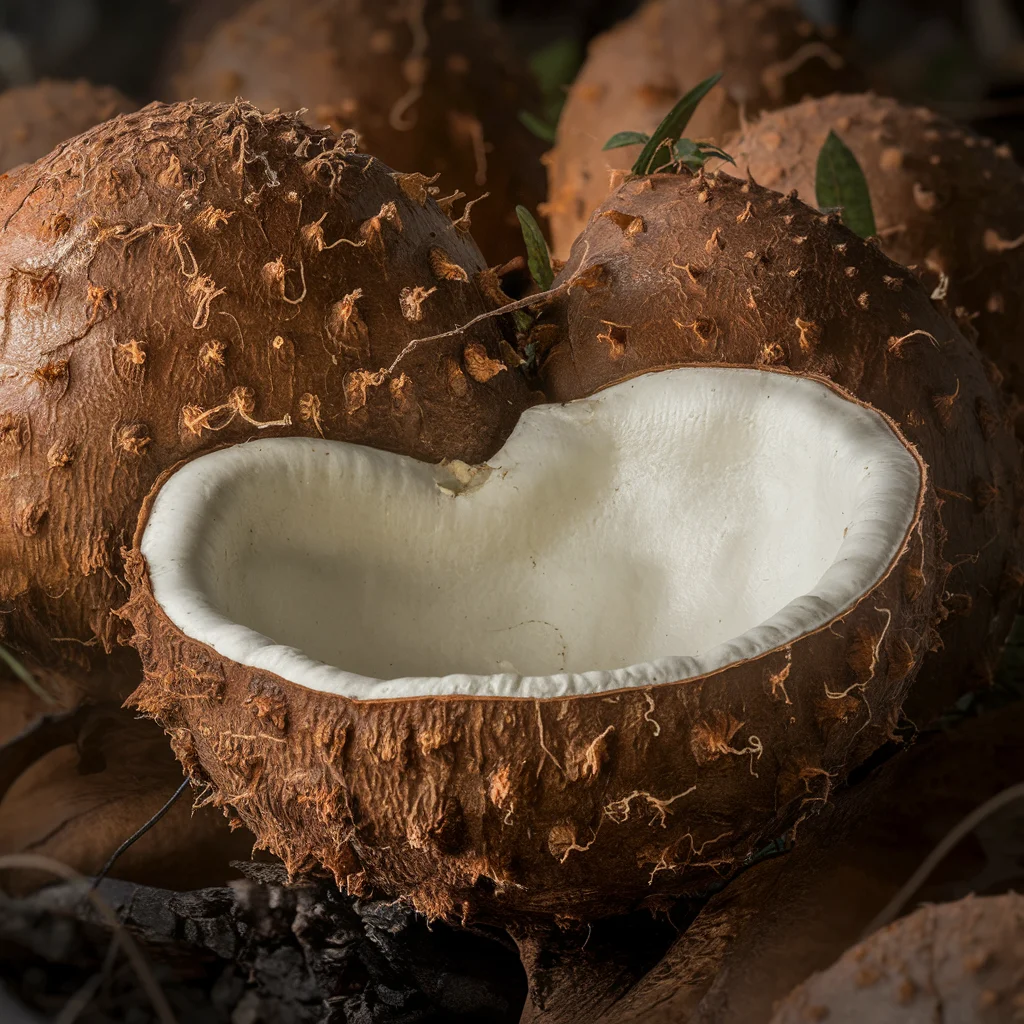
Wolfiporia extensa (syn. Poria cocos, Macrohyporia extensa) is a wood-decay fungus in the family Polyporaceae that forms large, subterranean sclerotia on the roots of pine trees (Pinus spp.) in warm, temperate regions of North America and East Asia. The sclerotium — the medicinally used part — is a compact mass of hardened mycelium that can weigh several kilograms, with a rough, dark brown exterior and a white, starchy interior. Known as Fu Ling in Traditional Chinese Medicine (TCM), it is one of the most prescribed medicinal mushrooms in the Chinese pharmacopoeia, documented in the Shennong Ben Cao Jing (circa 200 CE). Key bioactive constituents include pachymic acid and other lanostane-type triterpenoids with anti-inflammatory and anti-tumor activity, along with beta-glucan polysaccharides demonstrating immunomodulatory, diuretic, and sedative properties.
#22
Populariteitsrangschikking
Moderate
Onderzoeksniveau
2
Referenties
4
Belangrijke verbindingen
Independent Research Review · Laatst beoordeeld 3 mei 2026
Poria heeft matige wetenschappelijke onderbouwing met meerdere preklinische studies en enkele klinische studies. Meer onderzoek is nodig om de voordelen te bevestigen.
Poria — known as Fu Ling in Chinese medicine — is not what most people picture when they think of a mushroom. Instead of a cap and stem, Poria forms a large, underground mass called a sclerotium that...
Poria wordt al eeuwenlang gebruikt in traditionele geneeskundige systemen, met name in de Traditionele Chinese Geneeskunde (TCM) en andere Aziatische geneeswijzen.
Historische context: Traditioneel gebruik garandeert geen werkzaamheid of veiligheid. Modern onderzoek om traditionele claims te valideren is gaande.
Poria — known as Fu Ling in Chinese medicine — is not what most people picture when they think of a mushroom. Instead of a cap and stem, Poria forms a large, underground mass called a sclerotium that grows on the roots of pine trees. It looks like a dark brown, rough-skinned coconut on the outside, with a white, starchy interior that has been sliced, dried, and used in Traditional Chinese Medicine for over 2,000 years. It is one of the most commonly prescribed ingredients in the entire Chinese herbal pharmacopoeia.
People turn to Poria primarily for digestive comfort, anxiety relief, and better sleep. In TCM, it is classified as a Qi tonic that drains dampness — which in practical terms means it has been used to reduce bloating, water retention, and digestive discomfort. Its calming properties have made it a go-to ingredient in traditional formulas for insomnia and anxiety, often combined with other calming herbs. Modern research has identified triterpenoids like pachymic acid that may explain these sedative and anxiolytic effects.
Historically, Poria holds an almost unmatched pedigree in Asian medicine. It appears in the Shennong Ben Cao Jing, one of the oldest known herbal texts (circa 200 CE), where it is listed as a superior herb — meaning it was considered safe for long-term use and beneficial for overall vitality. Chinese emperors reportedly consumed Poria regularly as a longevity tonic. It remains a key ingredient in many classical TCM formulas still prescribed today, including Si Jun Zi Tang (Four Gentlemen Decoction) for digestive weakness.
In supplement form, Poria is available as capsules, powders, and tinctures. Hawaii Pharm (already represented in the Shroomaps brand database) sells dedicated Fu Ling tinctures. It also appears in many multi-mushroom and TCM-inspired supplement blends. Typical dosages range from 500 mg to 3,000 mg per day of dried extract. The mushroom is also used in traditional Chinese cooking — Poria cakes and Poria tea are popular in southern China.
When shopping for Poria supplements, look for products that specify whether they use the whole sclerotium or the inner white portion (called Fu Ling) versus the skin (called Fu Ling Pi), as different parts have slightly different properties. Hot water extraction is the standard method for polysaccharide-rich extracts, while alcohol extraction captures more of the triterpenoid compounds. Dual extraction products offer the broadest spectrum of benefits.
Poria combines well with other calming mushrooms and adaptogens. Pairing it with reishi for a comprehensive relaxation stack is a classic combination in TCM. It also works well alongside ashwagandha or passionflower for sleep support. For digestive applications, combining Poria with ginger and licorice root follows traditional TCM formulation principles. While Poria may not have the name recognition of lion's mane or reishi in Western markets, it is arguably one of the most time-tested and well-documented medicinal mushrooms in human history.
Topproducten met geverifieerde Wolfiporia extensa extracten.


Deze informatie is uitsluitend bedoeld voor educatieve doeleinden en mag professioneel medisch advies niet vervangen. Raadpleeg altijd een gekwalificeerde zorgverlener.
Independent Research Review
Independent editorial team reviewing product labels, COAs, regulator records, and cited scientific literature. our editorial team reviews all mushroom encyclopedia entries for scientific accuracy, ensuring claims are supported by peer-reviewed research.
Laatst beoordeeld: 3 mei 2026
Click anywhere or press Escape to close