$19.99 $19.99/serving
View Profile You must be at least 21 years old to enter this site.
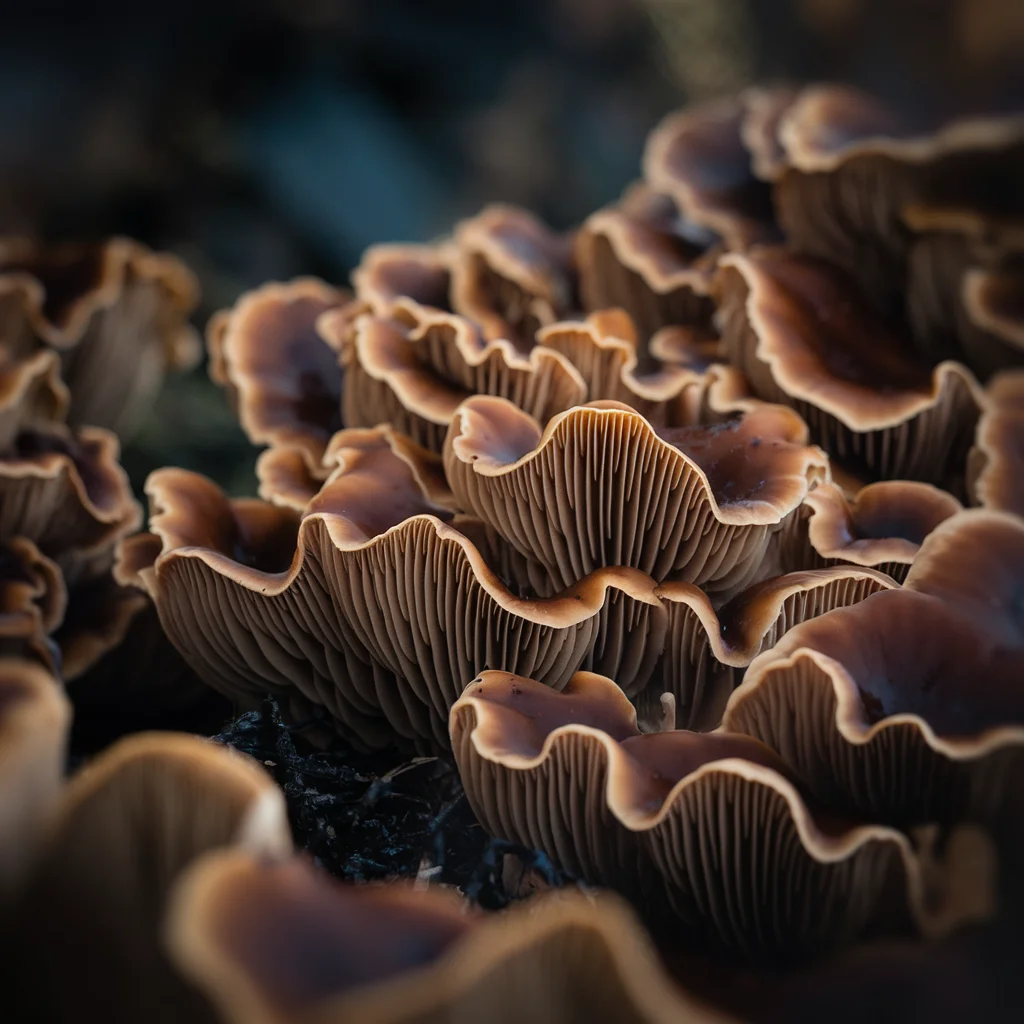
Psilocybe cyanescens is a potent psilocybin-containing basidiomycete of the family Hymenogastraceae, distinguished by its characteristically undulating (wavy) cap margin. The pileus is 2–5 cm in diameter, caramel to chestnut brown when moist, fading to pale buff when dry (hygrophanous), with a distinctive wavy or rippled edge at maturity. The stipe is 3–8 cm, white, and bruises strongly blue — a hallmark of psilocybin oxidation. P. cyanescens is a wood-decomposing saprotroph that fruits prolifically on lignin-rich substrates, particularly wood chip mulch, in the Pacific Northwest of North America and increasingly in urban and suburban landscapes across Europe, Australia, and New Zealand. It contains psilocybin at concentrations of 0.85–1.96% dry weight, making it significantly more potent than P. cubensis. Its spread via wood chip mulch in landscaping has made it one of the most commonly encountered potent psilocybin species in temperate urban environments.
#31
Popularity Rank
Moderate
Research Level
3
References
4
Key Compounds
Independent Research Review · Last Reviewed February 25, 2026
Wavy Caps (Psilocybe cyanescens) is a psychoactive mushroom or truffle entry with a moderate level of research context. Its key compounds - Psilocybin, Psilocin, Baeocystin, Norbaeocystin - should be evaluated through legality, product testing, mental-health screening, medication interactions, and setting risk. Clinical psilocybin findings come from supervised protocols and should not be treated as proof that unregulated consumer products are safe or legal.
Buyer decision guide
Use this section to separate clinical research, product marketing, legal status, and safety risk before making decisions about wavy caps.
Wavy Caps is a psilocybin-containing mushroom entry, but species names and informal strain labels do not make consumer material equivalent to clinical research material. The strongest human evidence concerns screened studies with controlled psilocybin, professional oversight, and defined endpoints, not unsupervised mushrooms, sclerotia, or cultivar names.
Psilocybe cyanescens may fall under psilocybin or psilocin controls in many jurisdictions. Local rules vary and can change, while decriminalization, sclerotia labels, or vendor language should not be treated as legal clearance.
Unregulated labels cannot verify species identity, alkaloid content, adulterants, storage history, or contamination. Closely related species and reused common names make identity checks more important than marketing names.
People with personal or family psychosis or bipolar history, serious cardiovascular disease, pregnancy, or serotonergic and psychiatric medications need clinician-level risk review. Acute distress, confusion, chest pain, or prolonged symptoms require medical help.
Wavy Caps has moderate research support with several preclinical studies and some human trials. More research is needed to confirm benefits.
Wavy Caps — Psilocybe cyanescens — are among the most potent commonly encountered psilocybin mushrooms in the world. Named for the distinctive wavy, undulating edge of their caps at maturity, they...
Wavy Caps has been used in traditional medicine systems for centuries, particularly in Traditional Chinese Medicine (TCM) and other Asian healing practices.
Historical Context: Traditional use does not guarantee efficacy or safety. Modern research is ongoing to validate traditional claims.
Wavy Caps — Psilocybe cyanescens — are among the most potent commonly encountered psilocybin mushrooms in the world. Named for the distinctive wavy, undulating edge of their caps at maturity, they are a wood-loving species that has spread globally through the use of wood chip mulch in landscaping. Originally native to the Pacific Northwest of North America, they are now found in urban and suburban environments across Europe, Australia, and New Zealand, often fruiting in spectacular quantities in garden beds, parks, and along paths mulched with hardwood chips.
The potency of Wavy Caps is significantly higher than the more commonly known Psilocybe cubensis. With psilocybin concentrations reaching nearly 2% of dry weight, they can be roughly twice as potent as typical cubensis specimens. This means that dosing requires particular care — what might be a moderate dose of cubensis could produce an intense experience with cyanescens. A typical moderate dose is 1–2 grams dried, compared to 2–3.5 grams for cubensis.
Wavy Caps fruit in autumn and early winter, typically after the first cold rains, in temperatures between 2–13°C. They grow in dense clusters on wood chip mulch, particularly alder, birch, and other hardwood chips. The fruiting body features a caramel-brown cap that fades to pale buff as it dries, white gills that darken to purple-brown with spore maturity, and a white stem that bruises intensely blue when handled — one of the most reliable identification features.
The ecological story of Wavy Caps is remarkable. Paul Stamets, the renowned mycologist who has championed their documentation, has described how the species has essentially hitchhiked around the world via the wood chip mulch trade. Landscaping companies spread wood chips in parks and gardens, and P. cyanescens spores colonize this substrate, establishing new populations far from the species' original range. This has made them one of the most successful invasive fungi in urban environments.
For identification purposes, key features include: wavy cap margin (especially at maturity), caramel-brown hygrophanous cap, intense blue bruising on the stem and cap margin, purple-brown spore print, and growth on wood chips (never in grass or on dung). Important lookalikes to distinguish include Galerina marginata (deadly poisonous, also grows on wood) — the key difference is that Galerina has a rusty-brown spore print versus the purple-brown of Psilocybe.
Wavy Caps are not commercially available and are illegal to possess in most jurisdictions. This information is provided for educational and harm reduction purposes. If encountered in a jurisdiction where psilocybin is legal or decriminalized, the same principles of responsible use apply: accurate identification is critical, start with a low dose given the high potency, ensure a safe and comfortable setting, and have a trusted companion present. The intensity of the Wavy Cap experience can be surprising even for those experienced with other psilocybin species.
Top products containing verified Psilocybe cyanescens extracts.
Personalized dosage recommendations based on your experience level, body weight, and goals.
Independent Research Review
The editorial team reviews mushroom encyclopedia entries for sourcing, clarity, safety caveats, and citation support.
Last reviewed: February 25, 2026
Click anywhere or press Escape to close