Before adding Maitake to your routine
This is a legal, non-psychoactive functional mushroom guide. Talk with your clinician first if you take blood thinners, diabetes medications, immune-modulating drugs, or are in cancer treatment.
Best supplement form
Hot-water fruiting body extract with D-fraction or beta-glucan disclosure
Compare products that match the form most often recommended for Maitake.
Evidence summary
Moderate research
3 cited references reviewed for the Maitake guide.
For healthy aging
Immunity, Heart Health, Blood Sugar Support
See how Maitake compares with Reishi, Chaga, and Turkey Tail for older adults.
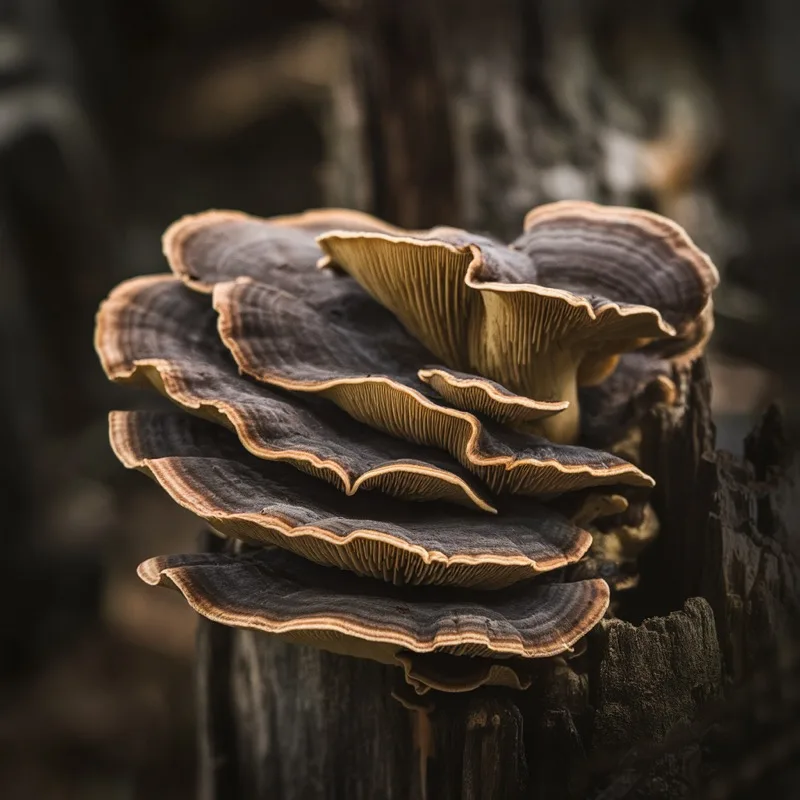
Grifola frondosa is a polypore mushroom belonging to the Meripilaceae family, found at the base of trees, especially oaks and maples, in China, Europe, and North America. Its morphology is characterized by large clusters of grayish-brown, spoon-shaped caps with wavy margins and a branched, cream-colored stipe. Key pharmacological properties include immunomodulation, blood sugar regulation, and potential anti-tumor effects, largely attributed to its polysaccharide constituents — particularly beta-glucans and the D-fraction, a purified beta-glucan extract with demonstrated immunostimulatory activity in clinical studies.
#7
Popularity Rank
Moderate
Research Level
3
References
3
Key Compounds
Beta-Glucans
Independent Research Review · Last Reviewed May 3, 2026
Key Takeaway
Maitake (Grifola frondosa) is a functional mushroom with a moderate level of scientific research supporting its use. Its primary bioactive compounds - Beta-Glucans, Polysaccharides, D-Fraction - have been studied for benefits including immunity, heart health, blood sugar support, weight management. Several preclinical studies and initial human trials support these uses, though additional clinical research is ongoing. Maitake is ranked #7 in popularity among functional mushroom species, with 3 cited research references in our database. The most commonly recommended form is hot-water fruiting body extract with d-fraction or beta-glucan disclosure. Typical supplemental dosages range from 500 mg to 3,000 mg per day depending on extract concentration and intended use.
Buyer decision guide
Maitake evidence, forms, and safety
Use this section to compare evidence strength, active compounds, researched forms, and safety limits for maitake.
Evidence snapshot
Maitake contains beta-glucans and polysaccharides studied for immune modulation and potential anti-tumor activity in preclinical and animal models. Human evidence remains limited; small trials suggest immunomodulatory effects in breast cancer and myelodysplastic syndrome patients. Cardiovascular and blood-sugar effects shown primarily in animal research. No disease-treatment claims are established in humans.
Active-compound check
Beta-glucans and D-Fraction (a polysaccharide extract) are the primary bioactive compounds. In vitro and animal studies demonstrate immune-cell activation and apoptotic effects on cancer cell lines. Human bioavailability and effective dosing remain under-characterized. Memorial Sloan Kettering notes preclinical antitumor potential but emphasizes early trial stage for human application.
Best researched form
Oral extracts (water-based and D-Fraction concentrates) have been used in most human immune studies. Whole fruiting-body preparations and culinary use are traditional but less studied in controlled trials. Extract standardization and dose-response relationships in humans require further quantitative research before clinical recommendations can be made.
Safety limits
Animal studies show maitake D-Fraction without acute toxicity. No serious adverse events reported in small human trials. Long-term safety, drug interactions (especially with immunosuppressants or chemotherapy), and individual tolerance thresholds remain inadequately studied. Consult a healthcare provider before use, particularly if immunocompromised or undergoing cancer treatment.
SCIENCE OVERVIEW.
Evidence Grade: B
Maitake has moderate research support with several preclinical studies and some human trials. More research is needed to confirm benefits.
Key Insight
In the 1990s, Japanese pharmacologist Hiroaki Nanba isolated a specific beta-glucan fraction from Maitake and ran it through immunological assays. The fraction — D-fraction — activated natural killer...
Traditional Use
Maitake has been used in traditional medicine systems for centuries, particularly in Traditional Chinese Medicine (TCM) and other Asian healing practices.
Historical Context: Traditional use does not guarantee efficacy or safety. Modern research is ongoing to validate traditional claims.
In the 1990s, Japanese pharmacologist Hiroaki Nanba isolated a specific beta-glucan fraction from Maitake and ran it through immunological assays. The fraction — D-fraction — activated natural killer cells and macrophages at rates substantially higher than beta-glucans from shiitake or other well-studied mushrooms. When tested alongside standard cancer treatments in mice, tumor growth dropped significantly. Nanba spent the next two decades building the clinical evidence that made Maitake D-fraction one of the most studied natural immunological agents in the world.
What Is Maitake?
Maitake (Grifola frondosa) is a dramatic mushroom that fruits at the base of oak trees in clusters weighing up to 50 kg in exceptional cases. Its Japanese name means "dancing mushroom" — allegedly reflecting the joy of foragers who discovered these enormous, prized clusters. It forms overlapping rosettes of fan-shaped gray-brown caps arising from a shared base, resembling a ruffled hen — hence "Hen of the Woods."
Maitake grows in deciduous forests of Japan, China, and North America, fruiting September through November. Wild Maitake is so prized in Japan that productive patch locations are closely guarded family secrets. In traditional medicine, it was used as an adaptogenic tonic for spleen and stomach disorders and to regulate what TCM calls "dampness" — a concept overlapping with modern metabolic syndrome and blood sugar dysregulation.
⚡ Key Fact
Maitake D-fraction is a 1,6-branched beta-1,3-glucan whose specific branching pattern optimizes binding to dectin-1 receptors on immune cells — making it more potent than standard beta-glucans from oats, yeast, or other mushroom species at equivalent doses.
The Science: How It Works
D-fraction's unusual potency relates to its specific branching pattern and molecular weight, optimizing binding affinity for dectin-1 receptors on macrophages and dendritic cells. This triggers NF-κB and MAPK signaling, activating phagocytosis, cytokine production (IL-12, TNF-α, IFN-γ), and NK cell activation. The Kodama 2003 study demonstrated measurable NK cell activity increases in cancer patients receiving oral D-fraction.
The metabolic effects operate through different mechanisms. The SX-fraction improves insulin sensitivity by increasing GLUT4 glucose transporter expression on muscle cells and reducing hepatic glucose output. The Xiao 2021 study found Maitake GF5000 fraction reduced fasting glucose and improved insulin resistance in diabetic rats through gut microbiome modulation — specifically increasing SCFA-producing bacteria that enhance peripheral insulin sensitivity.
Proven Benefits
- ✓NK Cell Activation: The Kodama 2003 clinical study demonstrated increased natural killer cell activity in cancer patients receiving oral D-fraction — clinically significant since NK dysfunction is associated with cancer progression and general immune vulnerability.
- ✓Blood Sugar Regulation: Among the strongest evidence in the functional mushroom world for metabolic health. SX-fraction and GF5000 show significant glucose reductions and insulin sensitivity improvements across multiple animal models, with gut microbiome modulation as a key mechanism.
- ✓Heart Health: Beta-glucans reduce cholesterol absorption by forming viscous gels binding bile acids. The combination of glucose regulation, cholesterol support, and anti-inflammatory activity addresses multiple cardiovascular risk factors simultaneously.
- ✓Weight Management: Maitake polysaccharides reduce adipogenesis and promote fat mobilization through adiponectin pathways. Not a weight loss drug — but as part of a metabolic health protocol, the multi-mechanism evidence is genuine.
💊 Recommended Dosage
1,000–3,000 mg/day of whole Maitake extract, or 0.5–1 mg/day of concentrated D-fraction liquid. For metabolic applications, take with meals. The Kodama NK cell study used ~2,000–3,000 mg/day equivalent. Also excellent as food — sear at high heat until deeply golden for exceptional flavor alongside medicinal benefits.
Maitake supplement options
Products containing Grifola frondosa extracts, with emphasis on verification, format, and practical daily use.
Find Your Ideal Maitake Dose
Personalized dosage recommendations based on your experience level, body weight, and goals.
SIMILAR SPECIES.
Maitake Guides & Articles
Editorial Reviewer
Independent Research Review
The editorial team reviews mushroom encyclopedia entries for sourcing, clarity, safety caveats, and citation support.
Last reviewed: May 3, 2026
Click anywhere or press Escape to close